Monday, January 24, 2011

One Week: No trial, no coup d'etat? What is the deal with JCD??


So what to make of Duvalier, one week and no coup d'etat later?  I don't think they weren't planning to stay for very long, I mean, his girlfriend Veronique Roy has been wearing the same outfit for days. The guy shuffles around his hotels, a face drooping with fear and weariness. What a wasted life: a terrible presidency which ended in exile; abandonment by his wife who took their stolen fortune with her; years spend puttering around France, not paying his debts and living off of hand outs from his few remaining supporters. He comes back to Haiti at a moment when a political vacuum is about to engulf the country, why?

I don't believe Duvalier is trying to make a vie for power.  If so, he has done all the wrong things. Of course, he was never a brilliant politician. By waiting several days to make a statement he lost the element of surprise, and left too many people wondering for too many days. And then, when he did finally say something, he left it up to two American consultants (Ed Marger and former Georgia congressman and presidential hopeful Bob Barr; the two of them are partners in a firm that seems to specialize in rehabilitating dictators) alongside his Haitian lawyer, Reynold Georges.  These men took questions in English rather than Kreyol, which instantly alienated most of the local press.  I believe Haitians would be unlikely to accept as a leader someone so obviously dependent on Americans for support. The press conference, which took place Friday, was a strange affair. Nowhere want to risk supporting him, so his people were kicked out of two venues before they decided to hold the conference in the tiny lobby of the guest house where the ex-dictator is renting a room. When Duvalier finally came out of speak, he spoke in a barely audible murmur, slurring his words as his read carefully from typed out statement.   In the speech he claimed that the reason for his visit was to show solidarity with his homeland on the anniversary of the earthquake, which he missed by a couple of days, supposedly for health reasons. He expressed sympathy for his supporters, many of whom who were killed in the dechokaj (uprooting) that followed his flight into exile.  He also offered a brief apology for those "to my compatriots who recognize, rightly, to have been victims of my government."


Duvalier has come to terms with the repressive force he required to bolster his regime. It is unclear whether or not Haiti, too, has come to terms. Memory, for better and for worse, is short.  There are many people, young and old, who hope Duvalier will take charge of the country and lead it in collective time-travel, back to the 1980's, and era remembered by affordable food, factories, and clean streets. There are others whose memories are less rosy, for whom the memory of oppression and state-sanctioned violence as not been erased by even-more-terrible things. Political activists like Boby Duval and Michelle Montas (both of whom were imprisoned, and in Duval's case, tortured under JCD) are filing complaints against the ex-dictator, which is the first step towards prosecuting him.  I think there would be much more vocal opposition to Duvalier in Haiti had not most of his opponents and his victims' families fled to live in the diaspora. However, apparently prosecuting a former leader for crimes against humanity is not the easiest thing in the world to do.  It is costly, takes many years, and requires experts from around the world. According to a friend of mine with UN connections, international community might not find it worthwhile if its just to take down one man and not the whole political cadre who perpetrated torture and assassination. And that would probably not be acceptable to Haitian social and economic elites, considering how many Duvalierists and Tonton maucoute have crafted new lives and identities for themselves.  Some have even been active in the Lavalas movement. 


Nevertheless, the most immediate question is the statue of limitations in Haitian law.  You can't try people from crimes committed more than 20 years ago. Duvalier fled the country 25 years ago. Does that mean that the people who suffered under his rule have no legal recourse? Duvalier's lawyers certainly seem to think so. I suspect they will be able to find a way around it though, if the other pieces fall into place.  
In addition to the question of limitations, the matter of "proving it" is tricky.  At the press conference on Friday, Duvalier's lawyer Georges boasted that "there is truth, and then there is judicial truth."  Basically, he said "we all know Duvalier committed crimes, but since you can't formally prove it, it doesn't count."  His lawyers also claimed (i imagine they bragged) that the case file that the Haitian government had against JCD was lost in the earthquake.  That is entirely possible, and very unfortunate if it is true. But that doesn't mean evidence can't be procured. Amnesty International has handed over to the Haitian prosecutors their entire dossier on the ex-dictator, which will probably furnish some damning evidence. Also, I have heard that activists have asked the United States to expedite the de-classification of State Department documents from the time of Duvalier. Supposedly diplomats and state department officials do a rigorous job of recording human rights abuses.  There is a precedent of this kind of evidence being used against human rights criminals in other Latin American countries, and it could be very important in bring Baby Doc to justice. The opening stages of a three-month investigation have begun.

The question everyone really wants to know about is the money.  Money is something everyone relates to and understands, and JCD's return would make a great deal of sense if we would just write it off to greed.  He has several million, the last drops the massive fortune he stole from Haiti's coffers,  stored in a Swiss bank account which has been frozen for the past year or so. People speculate that Swiss law required Duvalier visit Haiti and prove that he was not under persecution in order to reclaim the money. If that was their plan, they really blew it.  This sounds absurd to me, but I am no specialist in Swiss law.  Maybe he has to establish residency in Haiti. Doubtless the money is a factor in the equation, since the American consultants he brought it to represent him stated that it was their goal to retrieve it.  But they claim Duvalier would like to donate the money to reconstruction, and become a leader in the reconstruction movement.  Now that's hilarious. Bob Barr himself declares that he has come to help spread Duvalier's message of hope throughout the world. Their cynicism astounds me.  I don't believe I have seen someone so clearly full of  regret and sadness than  Jean Claude Duvalier.

Tuesday, January 18, 2011

JC Duvalier gets arrested!! JC Duvalier gets released!!

Check out this video to see my footage of JC Duvalier getting arrested: http://on.fb.me/htQll9

Today, despite itself, nothing was resolved. Jean-Claude Duvalier was "arrested" today, but it seems more like he was held for several hours in a courthouse (photocopies were made?), and then he was released, although apparently he is under investigation.  All morning we waited in the hotel where he was staying, watching the SWAT teams run up and down the stairs, changing the guard in front of his hotel room on the third floor. His spokesperson, a short man in an olive green coat, ran about furiously, at one point practically chasing us from the third floor stairwell where we had followed the police. He was shouting and scurrying.  Obviously things were not going as planned. At every moment, his arrest seemed imminent. A judge of the peace entered, went to the third floor. A police official entered, went to the third floor, and then exited.  Eventually a prison vehicle with caged windows backed its way right up to the entrance of the hotel and waited.  One of Duvalier's henchmen, the former ambassador to France, made a statement to the press saying that they "dared" the government to arrest the dictator.  But words are only words, and about an hour later Jean-Claude Duvalier descended the staircase of the hotel in the company of his wife, friends, and about a dozen Haitian police officers.  They exited the hotel from the back, with Duvalier getting into a private car that was driven by a policeman. The man never said a word. He looked broken, tired, sick.

Duvalier was taken to the courthouse downtown. It was announced all over the radio, and soon after he left the hotel men waving Duvalier's picture were throwing pieces of rubble into the street. It was a little too late to prevent them from arresting him, but it was a display of support none the less. However, it was a "half-hearted" attempt at a road block, and according to a friend the police were there soon after watching over as the men lifted the rocks from the street. By the time we arrived at the courthouse, two or three hundred people had gathered outside, watching with interest as the cars pulled up and the Haitian lawyers and the blan journalists poured out. Some of them were chanting pro-Duvalier songs. 


I interviewed a few people, both young and old. The older generation (those who remember life under Duvalier) was well represented in the crowd, but young people were there too. One man insisted that Duvalier had returned to Haiti to reinvest his millions in the poor country, and that other wealthy diaspora folk should do the same. Another man had been a functionary under Duvalier, and claimed that the Duvalierist, a very moderate group, had laid dormant for 25 years, but now that the dictator was back he was ready to sacrifice everything, including himself, to see him back in power. One woman was demanded that they release him immediately because they were certainly giving him cholera in the prison. I even interviewed a self-identified member of the Tonton Macoute (the volunteer militia, he said), who expressed his unqualified support for the return of Duvalier. When I asked people what they thought of the accusations that he stole millions of dollars from the Haitian treasury, they assured me that it was all lies.  The younger people I talked to, in their twenties, insisted that while they had no memory of the Duvalier era, the stories of their parents and relatives had convinced them that life was much better then and that his return could only be a boon for Haiti. But honestly, overall, I don't think people really cared that he was back, or that he got arrested. I think they are tired. It's just one thing after another. 


At one point the former ambassador to France made a statement to the press that was uncommonly emotional.  According to him, the news of  buildings destroyed in the earthquake, including the National Palace and the school where the dictator went to high-school, took an emotional toll on the man and he felt compelled to come back and reconnect with his country. Over a year after the quake. At a time of political crisis. He claimed that the arrest only happened when Duvalier's people announced that there would be a press conference. Preval doesn't want him to address the nation, he said. That is what has caused all of this.  Never mind the fifteen years of murder, corruption, and the theft of millions of dollars. Never mind the expired passport and the political vacuum. 


We waited, we waited. The rumor was he was getting released, and would be returned to his hotel. Duvalier never made a statement.  In the Haitian judiciary system, there are no charges like there are in America. The man is under investigation. For most Haitians, this would mean being held in the national penitentiary, possibly forever, without seeing a judge, but since Duvalier is a former president, they let him return to his hotel.  I guess he's too high profile to be a flight risk at this point. Supposedly the government had been building  a case against him for years, but the file was lost in the earthquake.The question at hand is if there is still definitive proof of his wrong-doing. When Duvalier returned to the hotel and escaped into the restaurant, I flashed a hotel key and scored a table right next to the dictator and his dictator-loving friends. If only I had cameras in my eyes. I would profile every face, try to understand each personality that sat with him and welcome him back with jovial smiles. But we kept a low profile, made up code words, and tried not to look at them too much.  We didn't hear anything unexpected.


So what does this all mean? What does this rule out? It would appear that Preval did not orchestrate Duvalier's return, although it still serves the purpose of distracting from the election results (oh yeah, announced tonight, the electoral consul will not be changing the results of the elections according to the OAS's recommendations. Apparently Mickey is still out and Celestin will be making it to the second round?)  My impression is that Duvalier was acting on his own, perhaps convinced by sycophants that he would find massive support in Haiti.  I still think he came here to die. The man seems like he has a degenerative muscle disease. His movements are very limited, in the face, neck and arms. He will probably still be arrested, eventually, although the Haitian judicial system is a maze I do not understand.  This will be a landmark case in Haiti and around the world, certainly. A murderous dictator returns, can a troubled nation bring him to justice? What would justice even mean?   Hopefully Haiti won't let this moment slip through the cracks. Yet unless there are massive riots tomorrow, I will feel confident saying this is almost a story more important to the journalists and historians and others who keep their eyes on the past, than to the Haitian people themselves. It does nothing to reduce their misery. Its impact on their lives is so small. 

Monday, January 17, 2011

Bon Retour J.C. Duvalier: Baby comes home

Last night Jean Claude "Baby Doc" Duvalier inexplicably returned to Haiti after 25 years of exile. This was absolutely not in the cards, and no one knows who is responsible for the move.  Until yesterday, Duvalier was only spoken about in the past tense. A relic, a nightmare, a joke. A few words about Jean-Claude's past: in 1971 he became president for life at nineteen years old upon the death of his father, the brutal dictator Francois "Papa Doc" Duvalier.  Jean-Claude continued many of his father's repressive policies of state terrorism, censorship, and control.  Thousands were killed, tortured or "disappeared."  However, Baby Doc did not possess the terrible genius of his father, and the carelessly destroyed the alliances and support bases that Papa Doc had cultivated.  He was known as a opulent playboy, and after his marriage to Michele Bennett, got the government involved in drug trafficking. In 1986, there was a uprising against him and the dictator and his family was forced to flee to France. He managed to take with him millions from the national treasury however, before fading into financial irresponsibly and oblivion.

And now he is back.  The moment is particularly ominous: the Haitian government is at odds with the Organization of American States about the outcome of the seriously problematic election that occurred in late November. There is supposed to be a run-off between the leading candidates, but there is serious disagreement about who the leading candidates are. The OAS's (also problematic) investigation has lead to the conclusion advised that the president's candidate leave the race in favor of Michel Martelly, a popular singer with a right-wing bent.  February 7th is technically the end of President Preval's term, and there is no clear leader to take over. In short, a power vacuum. Could this be why Duvalier came back? Does he hope to take back power at a moment when government is on its knees and trying to stand behind its weaknesses in the face of international pressure? 

Of course, there is the question of how he came back. He has been in exile, and forbidden to return, I think.  Who gave him a passport? Who on the inside authorized his return? The guy came in on a Air France flight for god's sake, not a private plane. He is a known criminal of serious proportions.  Murder, torture, drug running, the theft of millions from state coffers, you name it, and he could be held for it. But he has been here for 24 hours, hanging out at a hotel and avoiding the press, and has not been arrested. It's possible he has taken the government entirely by surprise. It is also possible Preval himself invited Duvalier back, some incredible game-changing move in the game he is playing with the international community.  What the next move is, nobody knows.

My personal theory is that Duvalier is dying, and he wants to die in Haiti. Or he wants to attempt amends at the end of his life. For what it's worth, in 2007, he issued an apology for all the corruption and violence of his regime. In the photos, he looks like a broken man. He looks sick. He certainly does not look like a man who could inspire confidence as a leader.  But then again, in leaderless and stumbling Haiti, who knows. There has been "bon retour JC Duvalier" graffiti scrawled for a long time on the walls of Port-au-Prince.

So what's next? The rumors are flying.  If Duvalier can come back, is Aristide next? That's really the burning question. Duvalier is still considered part of the past, even if arrived last night. People really want to know what this means for the one that matters in many people's hearts. Word is that Aristide is in Panama, that he is in Cuba, that he comes on Wednesday, that he comes next month, that he is still in exile in South Africa with zero plans to return. What could possibly be in store for Haiti?!?

Thursday, December 9, 2010

December 8th, and Why Martelly?

On Tuesday, election results were announced two hours late by a single official who sat alone at a table prepared for eight. The results? Manigat (grandmotherly former first lady) in the lead, with 31.37 %, Celestin (Preval's chosen successor) in second with 22.48%  and Martelly (popular musicien and badboy) in third with 21.84%. This was very bad news. (If you already know everything that's happening, skip to the bottom for an assessment of it)

The way Haitian elections are suppose to work, if no candidate gets more than 50% of the vote, the top two go on to a second round. In this case, Manigat and Celestin, ostensibly leaving Martelly out in the cold. However, his supporters were having none of it. Celestin a most unpopular man, and the election process was so riddled with corruption, criminal disorganization, ballot stuffing and intimidation that the margin of six-thousand some votes between Celestin and Martelly is negligible and probably fraudulent. Within fifteen minutes of the announcement, Martelly supporters in Petionville (where Martelly spends most of his time and money, and has large support base) were out in the streets, setting up flaming barricades, stopping cars, and breaking windows. Protesters sang political songs from the Aristide-era, inserting Martelly's name in all the appropriate parts.  At least one protester was in a pillaging mood, since he reached into our car and stole the cell phone out of the hands of my friend. From my house I could a half-dozen fires and heard spatters of gunfire throughout the night, although it is unclear who was shooting what.


    By 7:30 in the morning, the protesters had regrouped, and flaming barricades were visible up and down Delmas, the sounds of protesting oppression were clearly audible from my house: cheering, drums, chanting, screaming, the pops of tear gas and the booms of concussion grenades. Around noon we went to Place St. Pierre in Petionville, location of the old electoral office and site of much UN-Martelly tenison.  The UN troops used tear gas to keep the protesters away from the office, but they were releasing it basically next to a camp full of families. People (including children) inserted slices of lime in their noses to help with the pain, others smeared a citrus cream beneath their nostrils. At one point I saw the face of a woman sitting outside her tent transform with suffering as she began to inhale the gas and dove inside her tent. The camp inhabitants report that babies are particularly badly affected with gas and more than one child has passed out for over an hour after a tear gas attack. If the UN had the slightest consideration they would allow the protesters to move a bit closer so that at least the people they were targeting were the people actually demonstrating instead of innocent bystanders.

    From Place St. Pierre I hopped a moto with journalist TD in order to go get a sense of the town.  There were the chard remains of burning tires every few blocks, a tree pulled off the hillside to block the road, groups of protesters wandering through the streets, singing, yelling. Burning tires are an interesting thing: they are a very aggressive yet non-violent form of protest. They are a symbol of violence without requiring any violence itself. The aggression comes from the blaze and the huge amount of thick black smoke they produce. From afar a few tires can make it seem like a whole neighborhood is ablaze. And yet neither people nor property are injured.

        Things had obviously cooled off substantially from the morning, but there were still serious tension spots, like at the electoral office at Delma 41, were UN tanks had blocked off the streets and were having a stand off with hundreds of protesters. The whole thing has a rather theatrical element to it, since the protesters are throwing rocks at people wearing riot gear. Throw rocks, throw tear gas, run, repeat. We continued on our way, driving to ransacked the unpopular INITE (Unity) headquarters which were still smoking from earlier in the day when protesters burned the place down earlier after the security guard fired on them. Here the violence was real: rumor has it that protesters were shot, and in retaliation the whole place was destroyed. On the way back up Delmas we almost got de-moto-ed by some guys who had just set fire to a barricade and surrounded us, asking our driver to give him gasoline. When I said that we were the press (half-true) and that we needed to rush home to write articles and tell the world what was going on here, they were like 'oh, okay, no problem' and used a rod to move one of the tires out of the way so we could run through the black smoke to the other side and speed away.

     That afternoon at home I listened to Martelly's speech on the radio.  It was terribly brief, all he said was that people have the right to peacefully protest, and they should do so until VICTORY!  Kind of encouraging the protests, kind of not assuming responsibility for them.

     My two cents: These protests make perfect sense (and were rather predictable) in light of the past year of mind-numbing incompetence, corruption, negligence, and suffering.  The elections were a sham, and it is unlikely that any country or international authority is going to foot the bill for another try, especially with the obvious incompetence of the electoral counsel.  What I am curious to know is what Martelly means to people, exactly. I mean, why him? As a popular singer and a leader of Carnival, he is associated with positive, non- political aspects of Haitian culture. Having no prior experince with politics means that he is pure, uncorrupted.  But his political message, when its not completely vapid, is rather frighteningly right-wing. He talks about recreating the Haitian army (traditionally used only to suppress its own people), and he uses the motif of red and black, associated with the Duvalier era.  People seem to have forgotten that Martelly was a vocal opponent of Aristide (a widely beloved and now exiled president and 'champion of the poor') and supported both coups.  Its true that the elections are an embarrassment to democracy, and the people's anger and suspicion is completely justified. But they have seized on Martelly as their savoir not for what he is, but for what he is not.  I think they are using the language of politics to express otherwise unheard grievances: the need for work, the need for shelter, the need for respect in the eyes of the world. But Martelly has shown that he lack integrity and  is no more capable then Preval or anyone else to soothe international anxieties and bring much needed jobs to Haiti. I asked a woman  at a large pro-Martelly rally what Martelly would do for the people once he was president. Her response: "I'm not certain if Martelly will be able to change this, I mean we took to the streets for Preval too and he proved he wasn't able to do anything. But we have given professionals a chance and they have proven they aren't capable of helping us."

For me the sadness in this election is how little there is to aspire to.  All of the major candidates have made clear that they are far more interested in personal access to power than in the safety or stability of the Haitian people. Martelly, Celestin, and even Manigat have all issued statements claiming they think they deserve more of the vote. Celestin's people are threatening that they can 'unleash Cite Soliel' as if it was an animal in order to provoke a civil war. Martelly's people are claiming they won't stop until their man is president. Manigat thinks she should have won already.  These politicians are as embarrassing as the election that might bring them into power.

If you are intersted, look at my photos at http://picasaweb.google.com/erialcp/December8th2010#

Monday, November 29, 2010

Elections in Haiti

People lined up to vote in Port-au-Prince

Yesterday, after several weeks of rallies, concerts, and the occasional gunfight, thousands of Haitians turned out to vote. It was hard to believe yesterday that Haitians are politically apathetic. The atmosphere in the polling places was chaotic.People wandered from polling site to polling site, searching for their names. No one had been informed where they could vote. While the information was available on the internet, the internet is not accessible to most people in Haiti. In one school-cum-polling site, would be male voters stomped through the halls, shouting that their name didn't appear on the list since they were Martelly, rather than Celestin, supporters. Their agitated manner defined the mood, while those who were able to vote without problem passed silently around them. Even the president's chosen successor, Jude Celestin, was unable to find his name when he came to cast his vote.

Celestin himself seems harmless enough, but as Preval's chosen successor he represents continuity. Continuity is the last thing Haiti needs right now. However, since his campaign is funded by the government, his posters plaster walls all over the country, his campaign is broadcasted in 20 minutes slots on public television, airplanes fly his name through the sky. I've heard from many people that his cronies go into the camps and hand out money and pay people to register for his party. People take the money, but they assure me that their votes cannot be bought.

Jude Celestin posters in the gutter
There was much hand-wringing before the elections about whether or not they should go forward considering all the logistical problems of voter registration, polling sites, the of course the 200,000+ dead whose names were still on the voting lists. According to one person, the lists were both "bloated and incomplete". Some people are also angry that Lavalas, the party led by the exiled yet incredibly popular Jean-Bertand Aristide was excluded from participating from the elections. Many people who might have run on the Lavalas platform, for example front runner Ceant, ran with alternative parties. (Remember, in Haiti there are basically as many parties as their are candidates). People were also questioning the wisdom of having elections while so many people are living in tents and the cholera epidemic is spreading. All in all, the elections were being discredited before they happened

However, the consequences of not having the elections are also severe. The UN was pushing for the elections to illustrate that they had been doing significant work since the earthquake. The reconstruction process has been excruciating slow, in no small part because donors have been holding out until the new government is installed. Haiti politicians are notoriously corrupt and it seems foolish to hand millions of dollars over to a government that was on its way out of power. The peaceful installation of a new government is one of the most important elements to international support for reconstruction. Also, there is wistful possibility that new leaders might actually mean new governance in Haiti, and perhaps, even more wistful, a plan for the future. The government, the electoral counsel,and the UN, understanding the importance of stability for investment, probably hoped that a peaceful elections would be a litmus test for post-earthquake Haiti.

Too bad.


polling place in Port-au-Prince

Around 2 in the afternoon,12 of the 19 candidates came together in a press conference to denounce the elections as fraudulent.  Martelly, Manigat, Baker, Ceant, all the important front runners stood together and asked that the elections be canceled and that their supporters take to the streets. They claimed to have proof of voter intimidation and ballot stuffing, all part of a government plan to secure the election for Celestin. It would take some footwork on the government's part, for sure, considering hardly a single person in the past few weeks that I have met in the course of my interviews has expressed anything but disgust with Celestin and the present government.The press conference of the "group of 12," as some have called them, was played as a spontaneous intervention, but really, I wonder how long they had been planning this.  Why not call for the cancellation... before election day? 

Within a few hours, the streets of Port-au-Prince filled with people, mostly young men, chanting and dancing, waving Martelly posters high in the air. He was clear commander of the crowd (while it is easy to read this as Martelly winning the popularity contest, one has to keep in mind that those who support someone like the grandmotherly Manigat are probably more reliable to turn up at the polls and less likely to take to the streets). The march went up and down Delmas. At Place St. Pierre in Petionville the UN soldiers apparently used tear gas to disperse the crowd.  From what I saw, though, the mood of the crowd was wary and jubilant, but not angry. Some people even thought Martelly had already won.


The demonstrations lingered late into the evening. This morning, Martelly made a statement that the 12 candidates had made their demands, they had not been met, and the elections therefore would go on as planned. Basically, he backed down in order to allow the results of the election to still be valid. However, he did imply that the only means by which Celestin could win was fraud. Considering the massive public support this man is able to command, I suspect he has either been offered a position in the run off (this is just election round one, believe it or not), or knows that whether or not there was election fraud, he is still going to win. He is certainly distancing himself from the forceful statement he made the day before. Maybe it was a spontaneously organized (and quickly regretted) gathering after all.  However murky his motives, the fact that he did not call his supporters to further action may have spared Haiti a day of widespread violence.

UN soldiers prepare to meet the protesters

Thursday, November 4, 2010

Does the Origin of the Cholera Matter?

Cholera is not native to Haiti. It's not a disease endemic to poor people the world over that spontaneously occurs when sanitation conditions reach a particular low point. The disease migration is actually a rather important historical pattern that has shaped the outcome of many a event: the infamous smallpox blankets that helped the British defeat the Native Americans in 1763; the decimation of the French forces by yellow fever in 1802 that paved the way for Haitian independence. Maybe I'm too optimistic here, but it seems that the cholera epidemic in Haiti today is not going to reach such catastrophic levels, but the point is, the introduction of disease matters. At the moment, all evidence suggests that cholera came to Haiti when a group of soldiers from rotated into a base on the Artibonite river. The sanitation system at the base leaves much to be desired: human waste is stored in large pools that are dug uphill from the river, and broken pipes on site have spilled untreated human waste into the environment. The people who live next to the base stopped drinking the water long ago.


Understandably, this is a very embarrassing situation for the United Nations mission in Haiti. At first they both denied the possibility that the base was responsible and insisted that their contractor was responsible for all matters of sanitation. Then the Centers for Disease Control (CDC)conducted tests and established that it was a South Asian strand of cholera, but insisted that the specific origin could not be established, and that energies should be devoted to prevention instead. Yesterday Dr. Paul Farmer of Partners in Health (also a special UN envoy) made a statement to the Associated Press, insisting that origin of the disease could and should be established, and that Harvard would be willing to do the tests. To claim that the strain could not be established, he said, was a political move to protect the UN from further possible embarrassment.

To date, approximately 442 Haitians have died. Its tragic but logical that the disease was introduced: its a natural consequence of migration, and the UN troop rotations are a form of migration. From beginning the UN could have just acknowledged that there might be unintended consequences to a influx of a large and diverse population of foreigners. Rather than denying the possibility and claiming infallibility, they could have devoted energy to making sure affected populations had access to clean water and rehydration salts. They could have used the blunder to make a show of UN compassion, coordination, and humanitarian assistance. It could have been an occasion from them to take the high road, and instead they did a cover up and hoped the questions of origins would go away.

Its too politically imprudent for many in the international community to take seriously, especially at a moment when Haitian disillusion with the military presence is high. And the lack of international outrage around this issue is very telling. The U.N. peacekeepers are suppose to be the good guys, so this is almost too horrible to contemplate. Hasn't any seen Erin Brochovich? The fact is the 430 deaths matter. Their families deserve an explanation. In this situation these people were not the causalities of their poverty, they didn't die of a lack of education, they died of cholera. Although from now on, cholera will be another way that poverty kills. And to claim that no one should worry about how they contracted the disease, that we would be wasting our time on "the blame game" or "pointing fingers" is tantamount to saying that their lives and deaths just don't matter. Which is maybe what the UN has been saying along. I didn't think so before, but now I am starting to wonder.

Wednesday, November 3, 2010

Sunday, October 31, 2010

Homeless and Handicapped in Cite Soleil

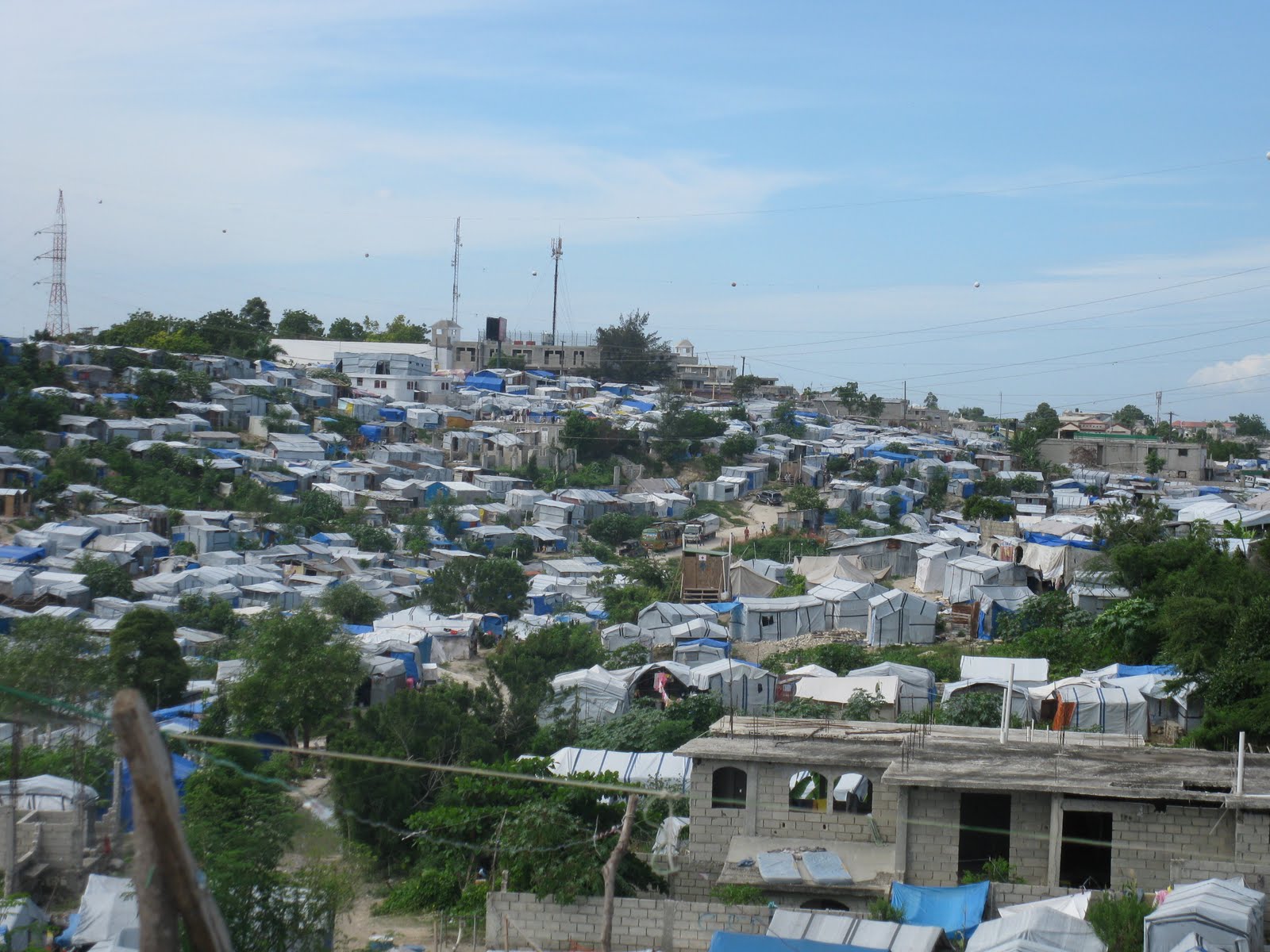
In the aftermath of the earthquake, doctors amputated thousands of limbs as a quick-fix procedure that would prevent infection. You see handicapped people everywhere these days in Port-au-Prince: an infant with one leg using a walker to stand for the first time on the edge of a soccer field; a legless man in a wheelchair cruising alongside the traffic on Delmas, going 20 miles an hour, swerving out of the way of rubble. Getting around Port-au-Prince on two legs was hard enough before the earthquake, before the buildings spilled out on to the street. So many limps, so many ghost limbs: uncomfortable reminders of the cost of survival. But some people have being dealing with handicaps in Haiti long before the quake. The other day Stan and I arrived in a Cite Soleil camp to interview a contact I had made a few weeks before. The camp, as it turns out, is run by a local association of the handicapped and the elderly and tries to cater to their specific needs. We interviewed Kevin, a thoughtful young man of 28 with a deformed arm who identified himself as the coordinator for Solidartie des Handicapes Moteur, a neighborhood organization that has been helping the handicapped since 1996. It was founded in reply to discriminatory treatment people with special needs were receiving in the neighborhood: verbal abuse, sexual abuse, general disregard of their human rights. I imagine social exclusion of handicapped folks happens in every culture, and Kevin gave an example of a man (now the president of the association) who was so afraid of how people treated him that he hardly ever left his family's house. In addition, the materials needed by the handicapped in Haiti are sorely lacking. What few wheelchairs are available are designed for limited indoor hospital use and absolutely inadequate for getting around a city like Port-au-Prince. They break too easily to ever be passed on to others. Canes and crutches are also in short supply. Solidartie des Handicapes Moteur (SOHAMO)worked to find materials like this, they helped the sick and elderly pay for prescriptions, and they even were running a small mirco-credit program when the earthquake struck. The organizations resources were destroyed, but a sense of solidarity among the members remained, and two weeks after the wake the leaders established a camp so that the elderly and the handicapped could help look after one another. There are over 300 people who live there. It's difficult but the camp tries to accommodate special needs: it is built on a cement lot and the tents are laid out to allow wheelchairs to pass easily between them. Kevin said that any group who wants to offer them aid or relief has to meet with them first to make sure that the services are accessible: for example, the showers come with seats for those who cannot stand.

The earthquake, Kevin said, is changing the way Haitians look at the handicapped. Everyone knows someone who lost a limb or was permanent disabled after the quake. It could be their children, their parents, their friends. So they have more patience now, he said, and they show more respect. The earthquake has also created a space of revindication: the demands of the handicapped are heard much more loudly, and it is time for the state to assume more responsibility for this portion of the population. Although Kevin says the earthquake brought nothing good for him personally, for the Haitian handicapped, this moment of tragedy might transform into a opportunity.

Tuesday, October 26, 2010

Let's Talk About Cholera

The bad news: as I'm sure anyone who reads this blog knows by now, thousands of people have come down with cholera in the Artibonite, about 50 miles north of Port-au-Prince. There have been about 300 deaths so far, all inhabitants of that region. The rumor mill has it that the UN might be responsible for the outbreak: the Nepalese base is located in St. Marc near the Artibonite region. In September there was a cholera outbreak in Nepal, so if there was a Nepali troop rotation recently, its possible (probable?) one way or another their waste made it into the Artibonite river, and into people's drinking water. Nothing has been confirmed, but its all over the radio and television here. The deaths in the north are tragic and tragically unnecessary (of all the things Haitians already had to worry about, at least they didn't have cholera), but this has the potential to become a disaster of major proportions if cases start appearing in Port-au-Prince, with several million people densely packed together in camps and slums. Whether or not this develops into a major epidemic, the cholera bacteria is now present in the Haitian water supply and will probably be a risk for people for many years to come. Even the DR is feeling the consequences, as tourists are reluctant to visit the island. So much for my mother coming to visit me for Christmas.

The mildly good news: So far there have been cases in Port-au-Prince, but they are all people who came from the Artibonite to the capital to seek care. So far, to the best of my knowledge, no one has contracted the illness in Port-au-Prince. Haitians and the international community alike are mobilized to educated people all around the country about water sanitation and to distribute water treatment tablets. Today I saw a van with speakers driving through the city announcing the wonders of hand washing and water treatments. Critics have been decrying the NGO world, saying they blew it (one particularly salient and well-written example can be found here: http://tinyurl.com/38nay48). The absence of a post-earthquake epidemic was the one success that the international community could claim, and now they've f-ed that up too. Putting aside the UN (they should really feel ashamed), I think it is too early to judge whether or not the development world has blown this or not. The introduction of the bacteria happened, there is nothing that can be done about that now, but really how treatment and prevention is really going to be what decides whether or not the NGO world here is legit or just a racket and a charade.

It's important to recognize that its not only the international community that is taking action. The responsibility for public health is also taken up by the Haitian government, community groups, and media outlets. The television and radio have been talking about cholera and prevention all weekend, the Ministry of Health is also mobilized and investigating the situation. Although in all fairness the Ministry of Health is probably inextricably tied to UN health organizations. But we must be on guard from thinking that this is solely the responsibility of the international world and ignoring the efforts, however constricted, of Haitians from helping each other. The expectation that Haitians can't take care of themselves is one of the modern day manifestations of colonial racism which is unfortunately still present in the development world today. Even if the reality is that Haitians need the NGOs for many of their most basic services like health care, we should never abandon the belief that Haiti should be taking care of itself.

Sunday, October 17, 2010

Addendum: Or How My Job Could Be Better

In my last post, I attempted to articulate a sort of mission statement, to describe why I am here and what I hope to accomplish. Two or three days ago, as I wound down a nearly two hour interview with a vodou priest, he asked me why I was doing this, and when I told him, he asked me if there were others working with me. No, I said, it's just me. You are not enough, he said. I know, I replied. And he is absolutely right, for so many reasons. First of all, I sometimes feel overwhelmed by my goal of 200 interviews, but ultimately, two hundred stories are nothing if you are trying, in a way, to take a snap-shot of a collective trauma. Five hundred, a thousand, maybe those could be a significant sample. To do that I would have to be able to enlist other researchers to go out in the field along side me. Of course, what are the future researchers of my imagined audience going to do with a thousand interviews? Two hundred interviews, making probably a hundred and fifty hours of audio, is already an overwhelming body of work to sort through. Somehow in the coming months I will find the means to transcribe all of this, and eventually get it translated into English so that the interviews can be accessible to the most people possible.

Also, I'm not Haitian so my sense of nuances in the Creole language is poor, and there are myriad culture references that are inevitably lost on me. In my dream world, I find the funding to buy more audio recorders (or...video!) and develop this project future with a team of three or five Haitian researchers, who would actually be the ones conducting the interviews. I learn a great deal from the contributions of my Haitian translator and co., whose personal investment in my project helps me learn themes Haitians themselves think important to document. The questions they think to ask are the ones that probably matter most. These teams would go out into the field while I dedicate my energies to transcribing, developing the database, re-listening to the interviews and summarizing them to make them more easily searchable to others. Maybe I would build a website so that people could access them from anywhere, not from the privileged location of a New York or Haitian archive.

I wonder sometimes if its a delusion to think that anyone else will ever listen to these or care about them? I don't think so, but it all depends on how I can make them accessible to others.

Friday, October 15, 2010

Why I Love My Job

It comes and goes, but at the end of today's work I was filled with the sense that the Haiti Oral History Project is very important. It helps that my Haitian translator, Stan, is into to it and is becoming more of a collaborator than a mere translator. The fact that Haitians themselves see value in my work is deeply validating, because ultimately, as Stan said, the preservation of earthquake memories will be much more important for them than for the handful of international academics. Over the course of my interviews, more than one person has told me that I am the first outsider who has been curious about their lives and their perspective on the earthquake. Obviously that fills me with a great sense of pride, but the Project is much bigger than just human-to-human connection.

I have respect for people who are fighting to protect the human rights of Haitians, to guarantee them shelter and health care. But that is not the only work here to be done. These people have seen and lived through terrible things, and now they are in the process of reconstituting lives for themselves from what remains. They are subjects of the crude social and economic experimentation of Reconstruction. For most, the lives they find themselves living are not the lives they want. And yet they are going forward, one way or another, often in spite of institutions that are supposed to be helping them. Let me be clear that moving forward does not mean moving on up. You might ask yourself when you hear news of Haiti, how can people live that way? I assure you that Haitians in the camps are asking themselves the same thing. The experience of the earthquake and the disappointments that followed are being absorbed into generation that will someday be gone. The Haitians who survived are the last ones that who know the world before everything fell down. They are the last generation who can tell you from personal experience how drastically things have changed. The new lives that they build will shape where Haiti will go next. In order to understand Haiti's future, we need the people who have memory of all three worlds: before, during, and after. Ordinary people's stories have incredible value because of the intimate way they present the historical moment and because they have insight into how humanity survives even in circumstances meant to destroy or ignore it. The Haiti Oral History Project is an effort to document and preserve the thoughts and memories of some of these people because without them, the most intimate meanings of the earthquake will be lost.

Wednesday, October 13, 2010

Interviews in Canape Vert

Certain areas in Canape Verte are completely devastated. House after house flattened up the entire hillside, some sliding into the houses beneath them. Knowing this was a particularly affected neighborhood, I decided yesterday to go check it out and see if my translator and I couldn't talk to some of the folks still living there. Here and there people had rebuilt shelters on the site of their destroyed house. Several sites were being cleaned up, the crushed homes being broken down into rocks and dust and carried away, leaving the surface of the earth empty and open. In one interview, we interviewed a woman while sitting on a porch overlooking the remains of the house as a young man broke apart cement and sorted through the rubble. They are cleaning it for me, she said. That house had almost killed her. She had been trapped, unconscious, for three days in the ruins of her kitchen. All her children are alive though, and she is grateful to be alive too. She thinks about the earthquake constantly, she said. She doesn't feel well. She slowly turned away from us turning the course of the interview until she wasn't facing us at all. I put away the recorder. We walked on.

Marie-Ange's shack is perched tenuously on the hillside, a small shelter amid a field of rubble and twisted rebar. She pushed aside the blue curtain when we approached and stood on the threshold while we explained what had brought us there. We were standing, she said, on the site of her old house, the house where she had been conceived and lived until January 12 2010, when the house above her house fell off its foundations and came crashing into her house, causing it to collapse. She took us out back and lo and behold there was the neighbors house lurching nonsensically, violently, downhill. The roof curved forward over the floors beneath it and reached nearly to the ground. It still stinks sometimes, she said. She and her family had been in the house at the time, but luckily they had made it to the front room when the above house fell, since that was the only part of the old house that didn't fall. Marie-Ange was five months pregnant with her first child on January 12th. That day she started to bleed, and on January 14th she had a miscarriage since they were unable to find a doctor. She spent a month and a half in the nearby camp, ill from the failed pregnancy, before returning the site of her house. In the meantime the rubble had been cleared from the site for her by a young men of the local soccer team. For the past ten years she had sponsored them, making food for them and washing their uniforms, and they wanted to do something kind for her. After the earthquake the survivors of the neighborhood had organized themselves and established a committee that sought out aid distributions and divided it peacefully among themselves. The foreigners are the only ones doing anything for us, she said. Well, God too. I asked her if her relationship with God had changed since the earthquake. "He's farther away now," she said.

I asked her what makes her happy these days, how she finds comfort when she is sad. She said all she really wants is another child. Her friends have children, her younger sister has children, all she really wants is to be able to have a child.The miscarriage was complicated though, and she doesn't know if it will be possible. She knows it is a gift from God, and isn't for her to decide, but she is waiting everyday with hope.

Everything has changed. It's a whole new world, she said.

Saturday, October 2, 2010

A Geography of Trauma

"Do you want to see the house?" We were driving up towards Petionville as the mid-afternoon rains started to mist the windshield. We drove past rows of painting that are mounted on the side of the road. In one, a the Marron Inconnu pulls the Haitian flag out of the crumpled National Palace; in another, dust settles on a post-earthquake destruction landscape. "Uh, sure. Why not?" I shrugged. I always wonder what they do with the paintings when it rains. Do they just leave them there? We turned off the main road, parked the car and got out. At the top of the driveway, he stopped. "This is where I stood in my boxers and called to report that there had been an earthquake." We continued down through the mist towards a small piece of land freckled with garbage, rubble, and few dumpsters. "And this was my house." I looked out over the emptiness. There was nothing there, but he spread out his arms. "Here's where the desk was, this where the wall fell down." Then he walked a few steps to the left."Over here, the kitchen. Here are where the stairs would have been, and here" he said, taking a few more steps and pointing to the sky, "was where my room was. I was sitting on my bed, right..about... here." He planted himself on the spot, defiantly alive and full of sadness.

The tour went on. I stood in the mist, kicking pieces of the kitchen floor and standing on top of a pile of rocks that used to form the walls. There were some shoes, a crushed video tape. "The landlords are happy. They've been wanting to tear this place down for years. They probably called America and asked for the earthquake just to get us out," he joked. He pointed to a flattened patch in the gray slum on the hillside and said that was where the church had been. "I knew it was bad because when I ran out, the neighborhood behind me was completely gone." We walked back up the drive way to the nearby hotel, which had stayed open after the quake despite that in certain parts the ceiling was elegantly cascading onto the floor. That's where he stayed for the weeks following the quake, sleeping in flowerbeds, writing reports, and feeling the terror of the first time with every aftershock that rolled through. As he told me his story, play by play, peppered with "This was where I was when...", I started to feel that I was full of ghosts. It's one thing to know that it happened, to know it was terrifying and that people were dying all around, for days. It's another to be standing on the spot with someone who points out the various places in eyesight that he saw people die. As witness to his rising anxiety, to the uneasy way he eyes the cracks in the walls, I was scoping out breadth and magnitude of that horrible moment with my heart. Standing there amid the ruins of his home, his loss of innocence could not be abstracted. It was on the ground all around him, beneath our feet. There is no good reason he survived, and he knows this.

I have known ruins. Despite the earthquake, the ruins of Port-au-Prince are still living. In fact, they maybe aren't ruins at all. They don't have the luxury of being ruins because they are still needed spaces. There is no where else for people to go, and so they live on top of, in front of, and even inside the spilled city. They are also soaked in living memory. Nearly every single fallen building is someone's profound loss of innocence, a place that full of someone's worst memories. With all these buildings taken together, we could compose a geography of collective trauma.

Wednesday, September 29, 2010

Not Everyone is Waiting for the Money

The island of La Gonave, like most of the Caribbean islands, used to be a pirate hang out. During the Revolution, General Leclerc asked Napoleon to give him the island as a reward for all is hard work trying to restore slavery to the island, that is, before he died of yellow fever. The island even had an American king for a few years the 1920's during the US Marine occupation. I spent the past week there, trekking around, talking about water scarcity and community organization and learning the art of Haitian cooking (hint: oil and tomato paste). Its a quiet, mountainous place, and the thick verdure in certain dark ravines gives you a hint of what the Haiti must been like back before Europeans laid claim to the land. Dusty uneven paths hug the mountain side as they stretch between thin fields of corn, and banana trees. Every mile or two a group of people are hanging out in the shade around a woman's basket of merchandise (always the same things), listening to the music on the radio. The island, which is a department of Haiti, has traditionally been neglected by the state and aid-organizations alike. It's not connected to the mainland, has only one town of any size, and is the home of maybe 30,000 people. La Gonave's state of neglect has not really changed since the earthquake, since the island did not suffer major destruction. But it's problems, especially access to water, are significant. According to a friend, institutional neglect has lead to a greater level of self-sufficiency among the islands communities. One of the communities I spent time in was based around a pastor's home up in the mountains. In 2000 a community organization called AJPDG (which translates into english as Young Peasant Association for the Development of Lagonav), based out of the pastor's home, established what they called the 12 Big Dreams, or goals that they wanted to realize in their area that are primarily based around education: free schooling in kreyol where students will have access to (potable) water, food, and where teachers will secure adequate pay. Sounds like goals certain places in America should be aspiring towards. In the past ten years this organization moved towards realizing many of its goals, without any sustained help from outside organizations. It was a pretty beautiful place. Apparently the way they fund their operations is by something along the lines of 'guerilla capitalism'. The schools run by their organizations have gardens where they teach the children about plants and farming, and the staples grown in these gardens is saved until well after harvest when food prices are high, when it is sold at community stores for a profit. The money is then reinvested into the organization to fund its further development. It's true that you don't come across sustainable community-based organizations like this everyday in Haiti, but AJPDG could be a excellent model for how Haitian communities can help themselves without relying on tenuous injections of outside financing or 'expertise'. Of course, AJPDG certainly benefits from the occasional presence of a mobile clinic or the gift of seeds for next season's crop. But what's important is that people doing the organizing are from the community, and can be held responsible for it's functioning over the long term, unlike programs that are set up by most foreign NGOs and do-gooder types. They are also the direct manifestations of the community's self-determination: they decided what they needed, it wasn't imposed on them. If more communities were able to organize like this one, its possible that the shameful tragedies of America's (and the world's) withheld aid could be mitigated somewhat.

Maybe that's an unfair comparison, since the communities on La Gonave were not shattered in the way that Port-au-Prince was. It's just refreshing to see a group of people getting things done instead of adhering to the mentality of dependence which can be so damning.

Port-au-Prince matters, certainly, but I think Haiti is still a profoundly rural society. Which means that the despite the earthquake, the fundamental problems of soil exhaustion, deforestation, erosion that plague La Gonave are still the key to understanding Haiti's predicament, even though they lack the shock value of a city turned to dust and uncountable deaths and never-found bodies. (Of course, these problems are magnified by the American economic imperialism that has driven many farmers out of business.) Is the earthquake primarily an urban problem? I'm certain the circulation of goods and produce was seriously disturbed by the earthquake. Also, the influx of food-aid seriously undermined the efforts of small-time farmers for a while, but now that most of that has been pulled, or never delivered, that might have normalized too. It's important to remember that the destructiveness of the earthquake is only a sign of Haiti's institutional weaknesses, not a primary cause of it. There are deeper, bigger problems that we might forget to address if we are only think about rubble removal and housing. Not to imply that those aren't important, but when and if those problems are even resolved, the long term problems of La Gonave and elsewhere in rural Haiti will have been continuing, unabated, and perhaps even exasperated.

Tuesday, September 28, 2010

Not Even a Hurricane

We've all known for some time that tents in Haiti that house hundreds of thousands of people were not going to cut it when the storms came. People say in passing, ah yes, things are bad now, and when the hurricanes comes,it will be even worse. The storms are coming, and things are even worse. On Friday there was a freak thirty minute storm with high speed winds blasted Port-au-Prince and killed at least six people. At least in one case, a tree fell on a tent, crushing a two children inside. Thousands of tents were blown apart, exposing people's fragile sense of normality to the elements. This wasn't even a hurricane! In the camp where I hang out, the tarps that made the roof of Twenty's tent were ripped off and the rain poured in over everything. It's great and all that this month the Haitian government is putting together a housing expo to show off possible model houses, but that maybe should have been done six months ago because right now peoples lives are on the line and there is nowhere for them to go. This is an absolutely unacceptable situation that has, somehow, become acceptable. People have begun to adjust to it. Hundreds of thousands of people squatting throughout the region in shabby houses made of plastic sheeting and tin is totally normal. Intolerably hot during the day, prone to flooding, and easily blown away in the winds, totally normal. It has been said that Haitians are very 'resilient' and 'adaptable', but as soon as this situation became tolerable Haitian leaders responsible for finding a solution were released from the pressure of 'NOW'. I want to believe this place is a time bomb about to explode with collective outrage, with people demanding basic human rights, but as far as I can tell, it's not. Some people say people are much to worried about meeting their day to day needs to concern themselves with social change. Others say people lost too much or too many in the earthquake, they are still in mourning. People will share their grievances with you when you ask, and the list is long. "Mwen blige akseptel": I'm obliged to accept it. You hear that phrase over and over. Maybe it's a reflection of the role of the church that encourages resignation and the patinent bearing of suffering. On tap-taps you see expressions like "The future is with God". The future may be with god but it's made by men and women. Are they obliged to wait for their homes to be destroyed in the next gust of wind? Are they obliged to wait for the hurricane that might crush their family as the huddle together to wait out the storm?

It's frustrating to see the intolerable become tolerable, but that might be because the Haitians know that the answer to those questions might be yes.

Monday, September 20, 2010

Voyage to the East Side of the Island

The first thing you notice flying over the east side of the island is the trees. I knew this already, I had looked at Hispanola on Google maps, I had seen the legendary line of foliage that divides east from west. But I wasn't entirely prepared for what the surviving jungle represented: the Dominican Republic has a more-or-less functioning state, a mildly healthy economy, a middle class. There are not women on every street corner selling produce in baskets, because many of them are inside, working at their jobs. Streets are paved, businesses have signs that light up at night. There are sushi restaurants for gods sake! Sushi! There were plenty of Haitians there, riding around on bicycles selling coconut juice or hawking paintings of cheerful tropical scenes on tourist strips. Haitians come to the DR for work, either cutting cane in the fields or working the informal economy. Haiti invaded the DR twice in the past two hundred years, at one point controlling the area for over twenty years. This has created a fair amount of resentment, and the supposed 'fathers of the Dominican Republic' on their bills are the men who liberated the country from evil Haitian rule. I got talked into buying a painting of a boat by a Haitian who claimed he lost eight family members in the earthquake. I feel like I am probably the only person to buy a trashy Haitian painting in the DR only to bring it back to Haiti. I felt bad for the guy. There is so much anti-Haitian racism in the DR, he said, I hate it here.

Santo Domingo's claim to fame is having the first everything in the New World. First colony, first church, first hospital, first fortress, first university etc. We're talking like 1490's, early 1500's. I got accidentally got picked up by a stray tour guide one morning who took me around the Zona Colonial and we peeked our faces into windows, looking at original this and original that. But when Santo Domingo is not trying to be original, it's trying to be New York. They recently installed a small subway system, New York style yellow cabs have begun to appear, and every other restaurant or laundry mat is named after the big apple. And of course, the Yankee's hats.

The ostensible reason for the trip, beyond learning to dance merengue and eating fresh seafood on the beach, was to go for Yom Kippur. There are only two synagogues on the island, both of which are in the Dominican Republic. Apparently in the Santo Domingo synagogue, the local rabbi had left some months ago, so a American ex-pat had been asked to lead the services. He is a modern orthodox Jew and he said he would lead under the condition that a divider would be put up to divide the men and the women of the congregation. The local Jewish community (also mostly ex-pats of various stripes but some Dominicans too) was not to happy about this but they figured they had to compromise when they had no one else to lead the service. In addition to that, the Yom Kippur service was led by a visiting Chabad Jew from Israel. So I found myself atoning for my sins and the sins of others at an orthodox Israeli service on a tropical island in the Caribbean. Dear Jewish God: May I never cease to be amazed by the confluences of cultural forces in the world. I gave fasting a try on Saturday, since I had never done it before, and let me tell you, walking around all day in wet heat not eating or drinking water leaves you feeling very very sorry for the things you've done. So sorry that I said screw it, I'm not even jewish, and drank a bottle of water. But even with this confrontation with my physical limits, my forays into the DR and into Judaism led me to a very interesting weekend.

Election Malaise

People all throughout this city are just waiting for something to change. However, its not the elections they are waiting for. On a small scale, some communities can address their own needs: clear a field of garbage to lay a garden, organize sports camps and schools. But on a fundamental and structural level this place is stagnating, and at this distance (both subjective and temporal) it doesn't seem like the November elections give anyone reason to get excited. Politics leave people pretty apathetic. That's a fairly natural reaction considering the assassinations, shootings, and disappearances that seemed to accompany the political activity of any kind from the 1950's till the early 2000s. Speaking out, organizing, attending a radical church, or even voting in national elections has historically led to massacres (usually at the hands or sanctioned by the Army or the secret militia of Tonton Macoute). So unless there is a reason to get excited, like Wyclef for example, its not really worth getting involved. Safer not to know and not to care.

Another part of the problem is that both sides of the great struggle of the recent era -Duvalierism and Aristide- are rather of washed out. Although you can't run as either as either of those groups officially (the first is in bad taste and the second is illegal), the political players on the scene now have roots in one or the other or both. The language that defined this struggle is still the language of politics today, although now it seems hollow, signifying nothing. Duvalierism is right-wing dictatorship, state control, order, noirism. A lot of people have been looking fondly upon the Duvalier years, which ended in 87, since the earthquake. You see lots of 'Bon Retour Jean Francois Duvalier' graffettied around town. The logic under a dictatorship at least shit would get Ladone. Aristides party, Lavalas, is the party of "the people", purporting to challenge American economic imperialism and make the amelioration of material conditions for the poor a top priority. Aristide made a name for himself as a supporter of liberation theology and daring and outspoke critic of oppression and violence during the junta that followed the Duvaliers. Through his preachings, considered radical by church and state, he gained a massive popular following that only grew the more times they tried to assassinate him. Though not a skilled politician, he was president for seven months in before being removed in a CIA backed coup in 1991. He was reinstated in 1994 with strict conditions, including the enforcement of neo-liberal political measures. He was president until 1996, then reelected again in 2001, but removed in another CIA backed coup (under Bill Clinton, who is now practically the Resident-General of Haiti), and has been in exile ever since. He party Lavalas was banned from elections, but many of the present day politicians cut their teeth in Lavalas (for example, the current president Preval served as Aristides prime minister).

All the major candidates in the current elections made their careers through involvement or accordance with one or another of these 'parties', or both. The fact that Alexis was a former prime minister, or Manigat was a first lady, none of these are actually endorsements. The fact that Manigat's husband worked for Duvalier and came into office in a discredited election and then was promptly duped out of the office and into exile, that's not really a glowing recommendation, is it? The fact that Preval was formerly involved in Lavalas means nothing about his contemporary political agenda. He's certainly not particularly worried about ameliorating the material conditions of the poor. The idea and the network of Lavalas might have meant something once, but it doesn't anymore.

The point is that the ideas that motivated both Duvalierism and Lavalas rouse little enthusiasm today, but another political language has yet to develop to take their place. People are still fighting the same old battles, thinking in the same old diachomy, and yet the realities of the world have moved on. I'm not saying that violent dictatorship is a thing of the past, or that addressing social inequality directly is passe, but rather the Haitian people aren't animated by the same ideas anymore, and politics has yet to catch up. The celebration of Aristides birthday, which has in the past brought out thousands of people, saw a demonstration of three hundred or so this year. Its possible that people too preoccupied with meeting their most basic necessities to get involved, but I don't think that's all of it. There's no lack of political conversation or engagement in Haiti, its just that people don't see themselves or a future they want reflected in anyone running. They just see more of the same old shit. The miserably low voting turn outs don't reflect only a lack of interest. They also reflect the deliberate rejection of a system that most people recognize as a charade. What Duvalierism and Aristides movement have in common is the charismatic leader. At the center of each is a magnetic personality that is able to mobilize thousands. They each came into power bring the promise of something new. The personalities in the up-coming elections are viewed as stale and compromised. That was the appeal of Wyclef: he was an outsider (less compromised), already filthy rich (less inclined to steal), and he mobilized people. Granted, his political platform was a over hashed pile of cliches, but the idea of him got people, especially young people, to want to get involved. The presidential debates this weekend were a joke. But this country doesn't seem to run on political platforms, it runs on political personalities, both of which are absent.

Thursday, September 16, 2010

Camp Ground News

I've dropped by the camp a few times now. I turn off the dust filled street and pass through the gate, waving to women who crouch in the shade of the trees. I pass the tables of men and boys playing domino along the path (this is a new development)and onto the dirt soccer field. It's pretty nice now, with the lines drawn with white rubble and netted goals on either end. There's a tournament going on this month, with individuals from the camp putting together teams from the whole neighborhood. Matches every afternoon at 4. A few hundred people show up. The winning team gets a goat.

Beautiful Sabine is pregnant again. She's a few months along, maybe she just found out or just decided to tell me. She wants a son. She has asked me to be the godmother of her baby. I love Sabine. One afternoon a few weeks ago I was crying in the camp in the mist of some disaster, and she took my head in her hands and stroked strands of hair out of my face. She insisted on walking me home, and when we passed by a hot dog vendor she took out a few crumpled bills and bought us sausages with hot sauce. I ate it gratefully, and I have to say that hot dog, given to me with sympathy by a girl living with her two kids in a tarp shack was the best tasting street food I have ever had the pleasure of eating, and I hate hot dogs. I have agreed to be the godmother to her child. I'm sure I'm getting in over my head here, but I wade willingly into the unknown.

There was a warm welcome for me when I first navigated my way to Twenty's tent through the labyrinth of tarps, ditches, and patches of corn. Rosemead was there, along with Twenty's model-esque girlfriend Kitt and some of their friends. They turned up the the music on their new speakers when I arrived, broke out some rum, and we caught up with each other's news. How was America? You've gotten fat! You missed Twenty's show, but that's okay, there'll be another one. Your mom is well? She let you come here again? No new aid distributions have come. Keep in mind that this is all happening in Kreyol, a language I can control liked a three year old. But hey, who says you need language to be friends? I can hardly ever understand Twenty, but then I just look at Rosemead, his sister, and she patiently repeats whatever he says slowly, more simply, and I laugh and nod. Bon bagay. Every afternoon these kids set up a table at the soccer game and sell rum, beer, cigarettes spaghetti and fritay. They definitely know how to make the most of a little. I sit with them at the games, occasionally putting away bottles and passing out plates of food, all the while admiring the players as they kick theatrically above their heads and headbutt the ball back and forth across the field. When I wander off Twenty shouts out after me, wants to know where I am going, wants to make sure I am safe.

I came back to Haiti with a digital camera for Kevins, my twelve year old photographer sidekick (thanks josh!! he loves it!!). Last time I was here I would give him my camera for days at a time. Most of the photos he takes are of him and his friends looking various shades of badass in different locations around the neighborhood, but some of his photos are of life in the camp. I have to say that they are so much more insightful than any photo I could take of this place. People aren't posing for him. They aren't suspicious of him, and so his photos are small windows into the vie privee of camp life. He catches graceful moments of painful boredom : a man lounging on sheets of metal with his head in the lap of a lover; a red-haired and pot-bellied baby causally chewing on cardboard; women carrying water. People all throughout this city are just waiting for something to change.

Saturday, September 11, 2010

Smackdown in Cite Soleil

Yesterday afternoon, as I was driving past Cite Soleil with journalist friends, I witnessed something that puts Haitian resentment towards the international presence here into perspective. As our car approached the intersection in front of the Commissariat (police station), a police and UN caravan emerged from the slum and pulled in front of us, with a large group of people running along side them. They looked more agitated and curious than upset. There was a man sprawled out in the bed of the police pick-up truck, obviously they had made an arrest in the slum. Chilean UN soldiers with flak jackets and guns took pictures of the scene with point and shoot cameras. As the trucks rolled into the Commissarat the crowd followed right up to the gates, until the UN soldiers started shouting and pushing them back across the street to let the traffic (us) pass through. We pulled forward slowly, doors locked and windows open, trying to figure out what was going on. Apparently we caught the attention of an intoxicated young man weaving towards us, small plastic cup of clarin in hand. He was shouting something and indicated to us to stop. I eyed the door lock uneasily as he sidled up to the car, but someone in the car said he was shouting that he was glad the press was there documenting this. A second later there was a Chilean UN solider at his elbow, shouting at him (in Spanish, most likely...) to back off from the car. He pulled at the guy, and when he kept pushing towards us the UN officer smacked the young man hard across the face. I gasped, the man doubled over slightly and brought his hand to his face, and the UN officer stalked off. We rolled forward a bit more and then came to a stop. The drunk man came up to the driver's side window, this time animated and angry. We were aghast that the UN soldier smacked him thinking that he was doing us a favor. He was like "you saw that? you saw that!?" and we replied something to the effect of "oh dude we totally saw that, that was so uncalled for i'm sorry that sucks." A crowd gathered around the car, listening to the conversation between the drunk man and the journalists. They wanted to know if we would write a story about this, show the world how Haitians are treated. It's no small surprise that some Haitians feel so degraded by the international presence that is basically running the country right now. They feel like they aren't respected or valued, just treated like poor dark garbage. They're opinions aren't listened to, their right to housing a joke, and in this case even their physical person is abused. I know a slap in the face is rather mild as far as physical violence goes, but it makes me think about what must happen when the threat is worse and there are no witnesses. Also, when violence like that is sanctioned, violence used by one foreigner to protect another group of foreigners from the inconvenience of having to engage with Haitians, it upholds the idea that the current occupation is just one more generation of oppressors in a long line of oppressors that can be traced back through the US occupation to the days of slavery, when blacks could only speak to whites with permission.

The cup of clarin had fallen out of his hand at some point, and in a few minutes the man had calmed down slightly and started to explain to us what had happened. Apparently that morning gang wars in the neighborhood had broken out into open fire, and several people were dead. Presumably, the arrested man was affiliated with one or another of the gangs. Did the police or the UN fire any of the shots, we asked. The crowd talked amongst itself, then decided that no, they had not. But the violence is really the NGO's fault, they explained. While they are not the ones pulling out guns, they aren't distributing the food equally among the different parts of the city, and this is causing group tensions to escalate to the point of violence. I wonder if the violence was an attempt to secure food resources, or if it was a expression of jealously and vengeance. You could argue easily against the logic that blames the NGOs for gang violence, but this is a place where the basic necessities of life are so hard to come by, given only by charity and sometimes taken by violence. I can see how easily those two forces can become interconnected in the eyes of the people who live at the whim of both.

Wednesday, September 8, 2010

The Comeback

After a four week hiatus in America, the Haiti Oral History Project is getting up and running again. I was so conflicted about returning. I will admit (as I did, often and loudly) that I dreaded going back. To put it mildly, Haiti is a very challenging place that tested me in ways I wasn't aware of and I sometimes failed. But I had already put the wheels in motion for a return trip and those wheels kept turning regardless of what I thought. My professor pulled some strings, broke some rules, and gave me his confidence to come back and do something awesome. But what kind of poor life choices had I made that this opportunity awaits me in godforsaken Haiti? It'd be so much easier to read books and drink beer with my similarly minded friends in Brooklyn, talking shit about the professors we aspire to become. What had I done?

I imagined simply not going. But within an hour of my arrival, the anger and fear in me melted. Tap-taps had new paint jobs, the smell of fritay my mouth water. Graceful women wove through the cars with baskets of avocados balanced on their heads. I started asking the guy who picked up me what he thought about Wyclef. Oh yeah, I remembered, I'm obsessed with talking with folks about Haiti. What is Haiti? Why is it? It was nice to have a month where I could try to talk about something else, but let's be real, I didn't succeed. If I hadn't come back I would have still be wondering the same things, just from afar, while those who engage with me do so first with interest, and then later with kindness. Here there are people who can feed my curiosity, who are as fascinated as I am, if not more so. This is where I belong. So I rented a room in boarding house and moved back. I've met a few of the folks who live here, asked timid questions about where my room is and how stuff works. I have a bed, a closet, a mosquito net, a pile of books, a few photos. It was a redundant of me to take photos of Haiti to decorate my room in Haiti. There will be no (mental) escape.

Underneath ripples of thunder the soft voices of my housemates drift off their balcony and through my window. The electricity flickers on and off. Whatever this becomes will be entirely my own creation. I know that sounds like hubris yet whether or not it is true it is what I believe.

Wish me luck, my friends.